Skip to content
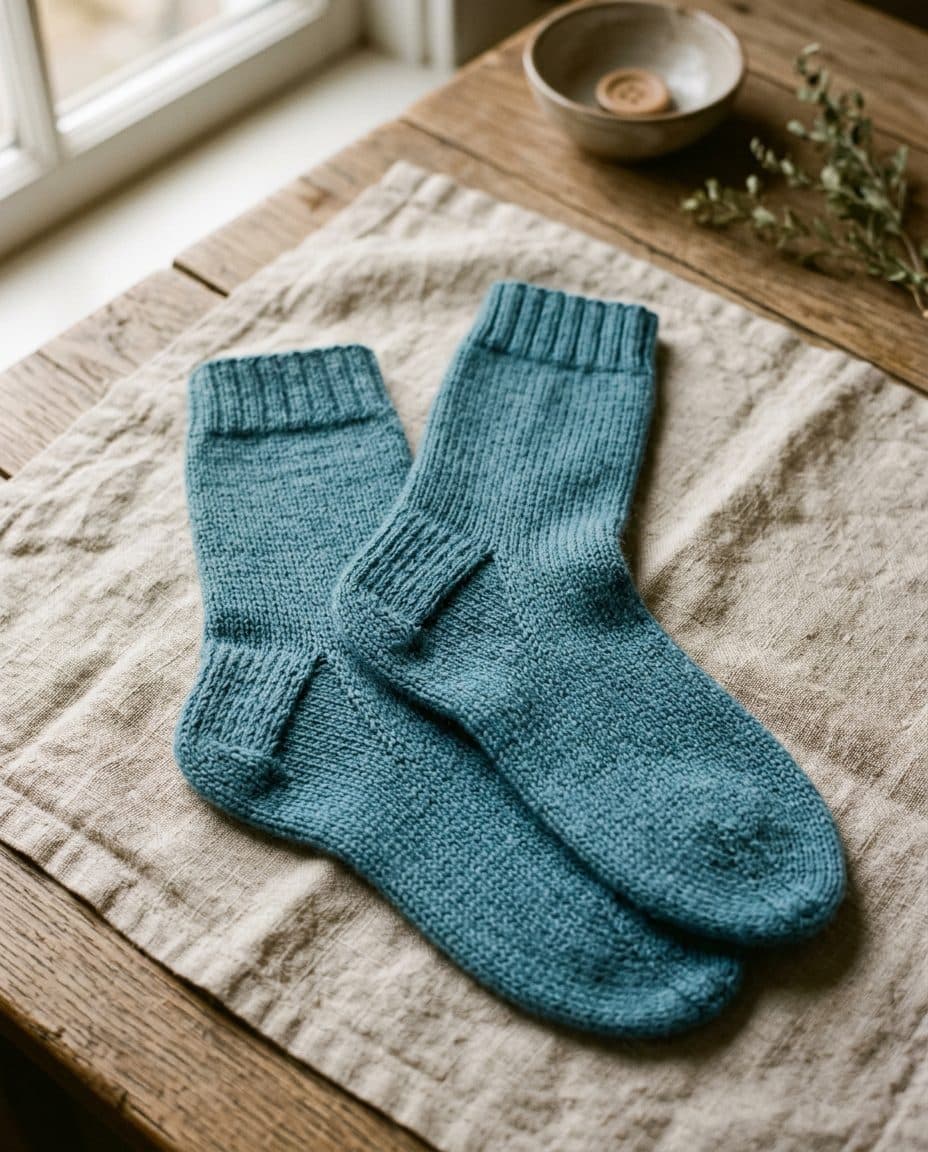
Trailhead Socks, preview render
Preview render

Free knitting pattern · intermediate · fingering weight

Trailhead Socks

Cuff-down fingering-weight socks worked in the round, featuring a 1×1 ribbed cuff, a classic slip-stitch heel flap with gusset shaping, and a smooth stockinette foot. Designed for an average adult foot.

Classic first sock

Finished / weight

Foot circumference: 8 in (unstretched); Foot length: adjustable; Leg length: approx 6 in from cast-on to heel

Gauge

32 sts × 44 rows = 4 in (10 cm) in stockinette with US 1.5 (2.5 mm)

Yarn

Fingering weight; 400 yards recommended (one 100g skein of approx 400–430 yds); wool, wool-nylon blend, or superwash wool suggested for durability

Needles / hooks

US 1.5 (2.5 mm) DPNs or 32–40 in circular needle for magic loop

Notions

Stitch markers (4), tapestry needle, scissors

Abbreviations

k = knitp = purlk2tog = knit 2 stitches together (right-leaning decrease)ssk = slip 2 stitches knitwise one at a time, then knit them together through the back loops (left-leaning decrease)sl1 = slip 1 stitch purlwise with yarn in back, unless otherwise notedsl1 wyif = slip 1 stitch purlwise with yarn in frontpm = place markersm = slip markerrnd = roundRS = right sideWS = wrong sidests = stitchesrep = repeattbl = through the back loopCO = cast onBO = bind offBOR = beginning of round markerM1L = make 1 left: lift the bar between stitches from front to back and knit through the back loopM1R = make 1 right: lift the bar between stitches from back to front and knit through the front loopktbl = knit through the back loop (twisted stitch)ptbl = purl through the back loop (twisted stitch)

Cast On

Cast OnUsing a long-tail cast on, CO 64 sts. Distribute evenly across DPNs or arrange for magic loop (32 sts per side). Join to work in the round, being careful not to twist. Pm for BOR.64 sts

Cuff — Twisted 1×1 Rib

Rnds 1–8*Ktbl, ptbl; rep from * to end of rnd.(8 rows)

Cuff — 1×1 Rib

Rnds 9–24*K1, p1; rep from * to end of rnd.(16 rows)

Leg — Stockinette

Rnds 25–44K all 64 sts.(20 rows)

Divide for Heel

Rnd 45K first 32 sts (these are the heel sts); the remaining 32 sts will rest on hold for the instep. Turn work to begin heel flap worked flat on the 32 heel sts only.

Heel Flap (worked flat on 32 heel sts)

Row 1 (WS)Sl1 wyif, p31. Turn.
Row 2 (RS)Sl1, *k1, sl1; rep from * to last st, k1. Turn.
Row 3 (WS)Sl1 wyif, p31. Turn.
Row 4 (RS)Sl1, *k1, sl1; rep from * to last st, k1. Turn.
Row 5 (WS)Sl1 wyif, p31. Turn.
Row 6 (RS)Sl1, *k1, sl1; rep from * to last st, k1. Turn.
Row 7 (WS)Sl1 wyif, p31. Turn.
Row 8 (RS)Sl1, *k1, sl1; rep from * to last st, k1. Turn.
Row 9 (WS)Sl1 wyif, p31. Turn.
Row 10 (RS)Sl1, *k1, sl1; rep from * to last st, k1. Turn.
Row 11 (WS)Sl1 wyif, p31. Turn.
Row 12 (RS)Sl1, *k1, sl1; rep from * to last st, k1. Turn.
Row 13 (WS)Sl1 wyif, p31. Turn.
Row 14 (RS)Sl1, *k1, sl1; rep from * to last st, k1. Turn.
Row 15 (WS)Sl1 wyif, p31. Turn.
Row 16 (RS)Sl1, *k1, sl1; rep from * to last st, k1. Turn.
Row 17 (WS)Sl1 wyif, p31. Turn.
Row 18 (RS)Sl1, *k1, sl1; rep from * to last st, k1. Turn.
Row 19 (WS)Sl1 wyif, p31. Turn.
Row 20 (RS)Sl1, *k1, sl1; rep from * to last st, k1. Turn.
Row 21 (WS)Sl1 wyif, p31. Turn.
Row 22 (RS)Sl1, *k1, sl1; rep from * to last st, k1. Turn.
Row 23 (WS)Sl1 wyif, p31. Turn.
Row 24 (RS)Sl1, *k1, sl1; rep from * to last st, k1. Turn.
Row 25 (WS)Sl1 wyif, p31. Turn.
Row 26 (RS)Sl1, *k1, sl1; rep from * to last st, k1. Turn.
Row 27 (WS)Sl1 wyif, p31. Turn.
Row 28 (RS)Sl1, *k1, sl1; rep from * to last st, k1. Turn.
Row 29 (WS)Sl1 wyif, p31. Turn.
Row 30 (RS)Sl1, *k1, sl1; rep from * to last st, k1. Turn.
Row 31 (WS)Sl1 wyif, p31. Turn.
Row 32 (RS)Sl1, *k1, sl1; rep from * to last st, k1. Turn. Heel flap complete — 16 chain selvedge sts on each side edge.

Heel Turn (worked flat on heel sts)

Row 1 (WS)Sl1 wyif, p17, p2tog, p1. Turn. (20 sts remain unworked)
Row 2 (RS)Sl1, k5, ssk, k1. Turn. (20 sts remain unworked)
Row 3 (WS)Sl1 wyif, p6, p2tog, p1. Turn.
Row 4 (RS)Sl1, k7, ssk, k1. Turn.
Row 5 (WS)Sl1 wyif, p8, p2tog, p1. Turn.
Row 6 (RS)Sl1, k9, ssk, k1. Turn.
Row 7 (WS)Sl1 wyif, p10, p2tog, p1. Turn.
Row 8 (RS)Sl1, k11, ssk, k1. Turn.
Row 9 (WS)Sl1 wyif, p12, p2tog, p1. Turn.
Row 10 (RS)Sl1, k13, ssk, k1. Turn.
Row 11 (WS)Sl1 wyif, p14, p2tog, p1. Turn.
Row 12 (RS)Sl1, k15, ssk, k1. Turn.
Row 13 (WS)Sl1 wyif, p16, p2tog, p1. Turn.
Row 14 (RS)Sl1, k17, ssk, k1. Turn. Heel turn complete — 20 heel sts remain.20 sts

Gusset Setup and Gusset Decreases (resume working in the round)

Gusset Setup RndWith RS facing and working in the round again: k across all 20 heel sts, then pick up and k 16 sts along left edge of heel flap (1 st per chain selvedge loop), pm; k across 32 held instep sts, pm; pick up and k 16 sts along right edge of heel flap (1 st per chain selvedge loop), k10 to reach new BOR at center of sole. Pm for BOR.84 sts
Rnd 1 (Gusset Decrease Rnd)K to 3 sts before first marker, k2tog, k1, sm, k32 instep sts, sm, k1, ssk, k to end of rnd.82 sts
Rnd 2K all 82 sts.
Rnd 3 (Gusset Decrease Rnd)K to 3 sts before first marker, k2tog, k1, sm, k32 instep sts, sm, k1, ssk, k to end of rnd.80 sts
Rnd 4K all 80 sts.
Rnd 5 (Gusset Decrease Rnd)K to 3 sts before first marker, k2tog, k1, sm, k32 instep sts, sm, k1, ssk, k to end of rnd.78 sts
Rnd 6K all 78 sts.
Rnd 7 (Gusset Decrease Rnd)K to 3 sts before first marker, k2tog, k1, sm, k32 instep sts, sm, k1, ssk, k to end of rnd.76 sts
Rnd 8K all 76 sts.
Rnd 9 (Gusset Decrease Rnd)K to 3 sts before first marker, k2tog, k1, sm, k32 instep sts, sm, k1, ssk, k to end of rnd.74 sts
Rnd 10K all 74 sts.
Rnd 11 (Gusset Decrease Rnd)K to 3 sts before first marker, k2tog, k1, sm, k32 instep sts, sm, k1, ssk, k to end of rnd.72 sts
Rnd 12K all 72 sts.
Rnd 13 (Gusset Decrease Rnd)K to 3 sts before first marker, k2tog, k1, sm, k32 instep sts, sm, k1, ssk, k to end of rnd.70 sts
Rnd 14K all 70 sts.
Rnd 15 (Gusset Decrease Rnd)K to 3 sts before first marker, k2tog, k1, sm, k32 instep sts, sm, k1, ssk, k to end of rnd.68 sts
Rnd 16K all 68 sts.
Rnd 17 (Gusset Decrease Rnd)K to 3 sts before first marker, k2tog, k1, sm, k32 instep sts, sm, k1, ssk, k to end of rnd.66 sts
Rnd 18K all 66 sts.
Rnd 19 (Gusset Decrease Rnd)K to 3 sts before first marker, k2tog, k1, sm, k32 instep sts, sm, k1, ssk, k to end of rnd.64 sts

Foot — Stockinette

Rnd 1K all 64 sts. Note: Try the sock on after several rounds to check foot length progress.
Rnds 2–29K all 64 sts.(28 rows)
Rnd 30K all 64 sts. Continue working even in stockinette until foot measures approximately 1.75 in less than desired total foot length. Then proceed to Toe Decreases.

Toe Decreases

Rnd 1 (Setup)Remove BOR marker. K16, pm (new BOR at right side of foot), k32 (sole sts), pm, k16. You are now at the new BOR.64 sts
Rnd 2 (Decrease Rnd)K1, ssk, k to 3 sts before first marker, k2tog, k1, sm, k1, ssk, k to 3 sts before second marker, k2tog, k1, sm.60 sts
Rnd 3K all 60 sts.
Rnd 4 (Decrease Rnd)K1, ssk, k to 3 sts before first marker, k2tog, k1, sm, k1, ssk, k to 3 sts before second marker, k2tog, k1, sm.56 sts
Rnd 5K all 56 sts.
Rnd 6 (Decrease Rnd)K1, ssk, k to 3 sts before first marker, k2tog, k1, sm, k1, ssk, k to 3 sts before second marker, k2tog, k1, sm.52 sts
Rnd 7K all 52 sts.
Rnd 8 (Decrease Rnd)K1, ssk, k to 3 sts before first marker, k2tog, k1, sm, k1, ssk, k to 3 sts before second marker, k2tog, k1, sm.48 sts
Rnd 9K all 48 sts.
Rnd 10 (Decrease Rnd)K1, ssk, k to 3 sts before first marker, k2tog, k1, sm, k1, ssk, k to 3 sts before second marker, k2tog, k1, sm.44 sts
Rnd 11K all 44 sts.
Rnd 12 (Decrease Rnd)K1, ssk, k to 3 sts before first marker, k2tog, k1, sm, k1, ssk, k to 3 sts before second marker, k2tog, k1, sm.40 sts
Rnd 13 (Decrease Rnd)K1, ssk, k to 3 sts before first marker, k2tog, k1, sm, k1, ssk, k to 3 sts before second marker, k2tog, k1, sm.36 sts
Rnd 14 (Decrease Rnd)K1, ssk, k to 3 sts before first marker, k2tog, k1, sm, k1, ssk, k to 3 sts before second marker, k2tog, k1, sm.32 sts
Rnd 15 (Decrease Rnd)K1, ssk, k to 3 sts before first marker, k2tog, k1, sm, k1, ssk, k to 3 sts before second marker, k2tog, k1, sm.28 sts
Rnd 16 (Decrease Rnd)K1, ssk, k to 3 sts before first marker, k2tog, k1, sm, k1, ssk, k to 3 sts before second marker, k2tog, k1, sm.24 sts
Rnd 17 (Decrease Rnd)K1, ssk, k to 3 sts before first marker, k2tog, k1, sm, k1, ssk, k to 3 sts before second marker, k2tog, k1, sm.20 sts
Rnd 18 (Decrease Rnd)K1, ssk, k to 3 sts before first marker, k2tog, k1, sm, k1, ssk, k to 3 sts before second marker, k2tog, k1, sm.16 sts

Toe Closure

Final RndK8 (to reach the first marker, aligning the 8 instep sts and 8 sole sts on opposite needles). Break yarn, leaving a 12 in tail.16 sts

Finishing

With 16 sts remaining (8 instep sts and 8 sole sts), graft the toe closed using Kitchener stitch: thread the tail onto a tapestry needle, hold the two needles parallel with RS facing out, and work Kitchener stitch (setup: enter front st purlwise, enter back st knitwise; repeat: enter front st knitwise and slip off, enter front st purlwise and leave on; enter back st purlwise and slip off, enter back st knitwise and leave on) until all sts are joined. Pull tail to inside and weave in all ends securely. Repeat the entire pattern for the second sock. Block lightly by soaking in cool water, pressing out excess water in a towel, and allowing to dry flat or on sock blockers.

Notes

Sizing: These socks are designed for an average adult foot with an 8 in circumference. For a smaller foot (7 in), cast on 56 sts; for a wider foot (9 in), cast on 72 sts — adjust heel and toe accordingly in multiples of 8. Foot length: Continue the stockinette foot section until the foot measures 1.75 in less than the wearer's actual foot length before beginning toe decreases. This accounts for the toe shaping. Gusset fit check: Slip the sock onto the foot after the gusset is complete to confirm the foot circumference is comfortable before continuing. Heel flap: The slip-stitch pattern on the heel flap creates a reinforced, dense fabric. Always slip the first stitch of every heel flap row for a neat selvedge. Yarn: A nylon-blend sock yarn is strongly recommended for durability at the heel and toe. Avoid 100% wool if the wearer is hard on socks. Two-at-a-time: This pattern can be worked two-at-a-time on a long circular needle to avoid second-sock syndrome — simply divide each sock's stitches across the same needle and work both simultaneously.

Knit this row by row — free

SkeinSmart keeps your place in any pattern, syncs across devices, and turns your yarn stash into a shopping list. Describe a project and get your own pattern in seconds.

Start tracking this pattern →

AI-drafted, human-run · this version drafted Sep 21, 2026. Always swatch and verify stitch counts before casting on.